Flexible connections play an important role in safe gas transfer, accommodating movement, and supporting operational uptime across well pads, gathering systems, compressor stations, and processing facilities.
If the wrong hose is selected, or if a hose assembly is used that isn’t designed for your specific operating conditions, it can result in:
- Production interruptions
- Increased maintenance requirements
- Safety risks
- Higher lifecycle costs
Coal seam gas operators are heavily focused on reliability, so choosing the right flexible connection plays a big role in ensuring operations are efficient.
The demands of coal seam gas infrastructure
Equipment and fluid transfer systems are placed under constant demand in coal seam gas environments. In typical CSG operations, infrastructure is exposed to:
- Ground movement and settlement
- Equipment vibration
- High-pressure gas transfer
- Thermal expansion and contraction
- Harsh weather conditions
- Corrosive environments
- Frequent maintenance activities
All these conditions create stress, especially on connection points where rigid pipework interfaces with equipment. If flexibility isn’t built into your system, movement and vibration transfers directly into pipelines, valves, compressors, and other critical assets.
The result? It accelerates wear and increases the chances of failures.
Flexible connections in CSG operations
What’s the purpose of flexible connections in CSG operations? They’re designed to absorb movement during gas transfer. In coal seam gas applications, they help to accommodate pipe misalignment, manage vibration from rotating equipment, reduce stress on connected assets, compensate for thermal expansion and contraction, improve installation flexibility and support easier maintenance access.
The cost of hose failure
No operators want unexpected failures. They can lead to:
- Unplanned shutdowns
- Lost production
- Additional labour costs
- Emergency maintenance callouts
- Project delays
- Increased safety risks
Managing static electricity during gas transfer
In coal seam gas operations, static electricity is a real risk. When gas moves through a hose, static charge can accumulate in the system. If it’s not managed properly, things can go wrong. For this reason, anti-static hose solutions are commonly recommended for oil and gas applications.
Pacific Hoseflex’s Vapflex® anti-static hose was developed specifically for the onshore oil and gas industry. Designed to resist corrosion while helping manage static build-up,
Vapflex® provides operators with a reliable solution for critical gas transfer applications.
With a 50mm diameter and pressure capabilities up to 2600 kPa, Vapflex® delivers dependable performance in demanding field conditions.
Metallic hose assemblies in CSG operations
What are the advantages of metallic hoses in coal seam gas operations? Pacific Hoseflex’s VITALFLEX® braided metallic hose has been trusted throughout the oil and gas industry for decades because of its ability to perform in demanding environments.
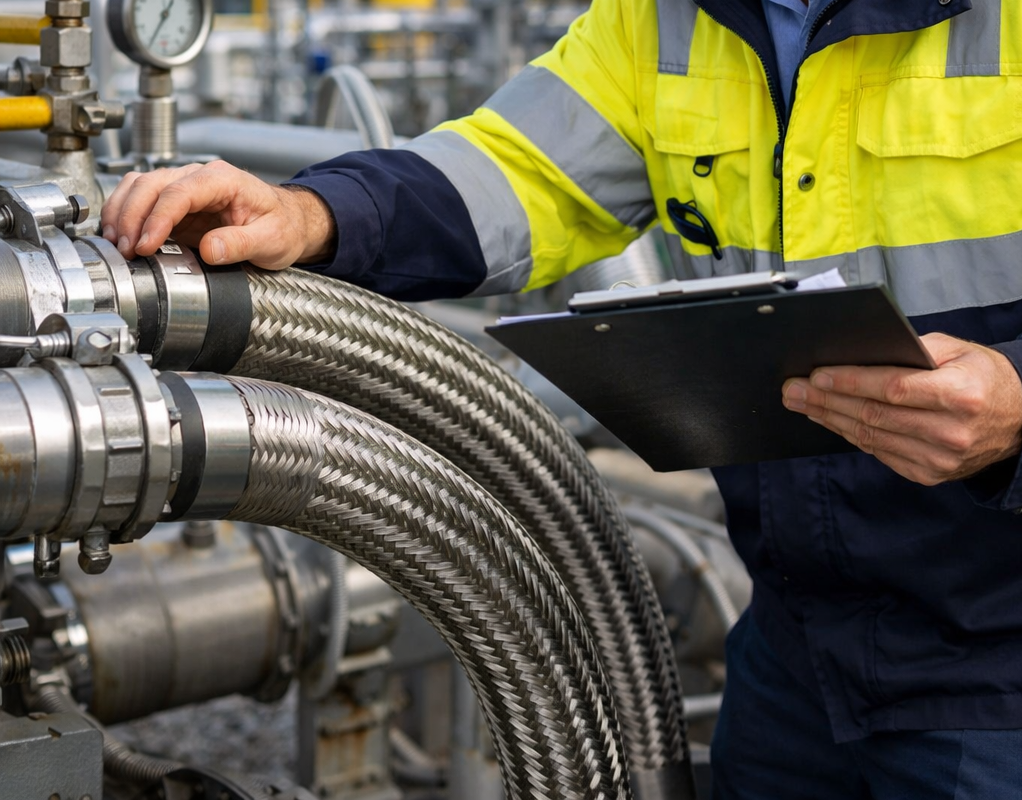
Its flexible, convoluted construction handles movement while still delivering incredible pressure capability. Independently certified to international design standards, the 50mm VITALFLEX® braided gas hose can withstand pressures up to 8900 kPa and offers a compact static bend radius of just 136mm.
Pacific Hoseflex – Supporting Australia’s coal seam gas industry
At Pacific Hoseflex, we have a long history of supporting Australia’s onshore oil and gas sector with high-quality engineered fluid transfer solutions.
Our range of oil and gas hose solutions includes Vapflex® anti-static hoses, VITALFLEX® metallic hose assemblies, fittings, couplings, expansion joints, and specialised gas transfer products designed to optimise performance and reduce downtime.
The Hoseflex team can help identify the right flexible connection solution for your application. Contact us to discuss your requirements and learn how engineered hose solutions can support your operations.